Table of Contents
- 1. 13 Card Indian Rummy: Basic Setup and Card Deal
- 2. Understanding Valid Combinations: Pure Sequences, Impure Sequences, and Sets
- 3. How Points are Calculated: High Cards, Face Cards, and Penalty Tiers
- 4. Comparison: 13-Card Rummy vs. 21-Card Rummy vs. Pool Rummy
- 5. Case Study: Amit Verma's Lucknow Club Tournament Win
- 6. Advanced Winning Tricks: Bluffs, Discard Analysis, and Joker Management
- 7. Frequently Asked Questions (FAQs)
- 8. Conclusion: Practice on Verified Apps and Play Responsibly
For card game enthusiasts in India, mastering 13 card indian rummy is the ultimate test of strategic planning, memory, and tactical skill. Often played with friends or on verified platforms (popularly referenced under searches like indian rummy card game or **trusted rummy app**), this game requires forming valid card combinations. Understanding the exact card grouping structures, point calculation criteria, and advanced winning tricks is key to dominating real-money lobbies. In this masterclass guide, you will learn the official rules, card distribution mechanics, point values, and tournament-grade winning methods to make your next declaration flawless.
Our expert analysis of 13-card rummy shows that forming a Pure Sequence (a consecutive run of cards in the same suit without a joker) is the most critical step. Without it, any declaration is automatically invalid, resulting in a maximum penalty of 80 points. Learn the rules below.
- 1. 13 Card Indian Rummy: Basic Setup and Card Deal
- 2. Understanding Valid Combinations: Pure Sequences, Impure Sequences, and Sets
- 3. How Points are Calculated: High Cards, Face Cards, and Penalty Tiers
- 4. Comparison: 13-Card Rummy vs. 21-Card Rummy vs. Pool Rummy
- 5. Case Study: Amit Verma's Lucknow Club Tournament Win
- 6. Advanced Winning Tricks: Bluffs, Discard Analysis, and Joker Management
- 7. Frequently Asked Questions (FAQs)
- 8. Conclusion: Practice on Verified Apps and Play Responsibly
1. 13 Card Indian Rummy: Basic Setup and Card Deal
The game begins with the dealer shuffling two standard 52-card decks. A random card is pulled from the deck and placed face up in the wild joker slot. For instance, if the 8 of Hearts is drawn, all 8s in all suits become wild card jokers. Printed jokers also act as wild card jokers. Each player is dealt exactly 13 cards, one at a time. The remaining deck is placed face down to form the closed deck, and the top card is placed face up to start the open discard pile.
Players must sort their cards by suit to plan their moves. During each turn, a player must draw the top card from either the closed deck or the open discard pile and then discard one card from their hand to the open pile. The goal is to form valid groups of cards before your opponents do.
2. Understanding Valid Combinations: Pure Sequences, Impure Sequences, and Sets
To win, your 13 cards must be arranged into valid groups. Any random card grouping that doesn't follow these guidelines is penalized as an invalid declaration:
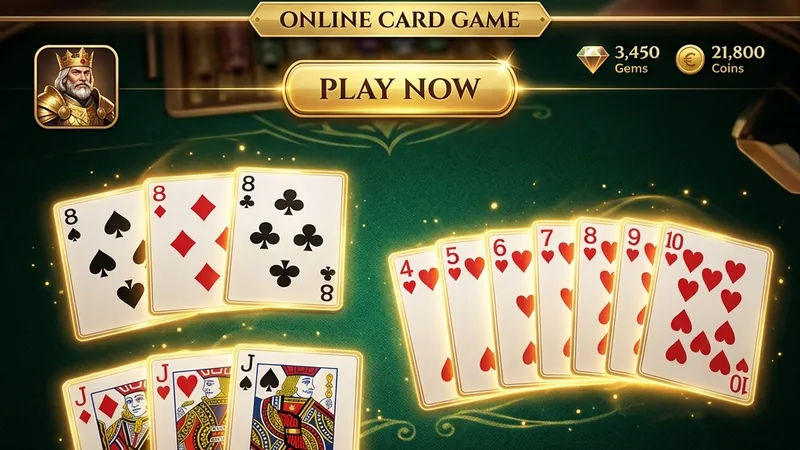
- Pure Sequence: A run of 3 or more consecutive cards of the same suit. No wild card jokers or printed jokers can replace a card in a pure sequence. Examples: 5♥ - 6♥ - 7♥ or A♠ - K♠ - Q♠ - J♠. This is the foundation of a valid hand.
- Impure Sequence: A run of 3 or more consecutive cards of the same suit where a missing card is replaced by a wild card joker or a printed joker. Example: 3♣ - 4♣ - PJ (Printed Joker) or 10♦ - 8♥ (Joker) - Q♦ (where 8 is the wild joker).
- Sets: A group of 3 or 4 cards of the same rank but different suits. A set cannot contain duplicate suits. Example: K♥ - K♠ - K♦ is valid, but K♥ - K♥ - K♠ is invalid. Jokers can also be used to complete a set. Example: 7♣ - 7♦ - PJ.
3. How Points are Calculated: High Cards, Face Cards, and Penalty Tiers
In 13 card indian rummy, points have a negative value. The player who makes a valid declaration first gets 0 points and wins the round. The losing players get points based on the unarranged cards in their hands. Face cards (Ace, King, Queen, Jack) carry 10 points each, while numbered cards carry points equal to their face values. Below is the point chart:
| Card / Action | Point Value | Penalty / Score Rule |
|---|---|---|
| Ace, King, Queen, Jack | 10 Points each | Negative points if unarranged |
| Numbered Cards (2 to 10) | Face Value (2 to 10 points) | Negative points if unarranged |
| Jokers (Wild & Printed) | 0 Points | No negative points, can be grouped anywhere |
| First Drop | 20 Points | Dropping on your very first turn without drawing |
| Middle Drop | 40 Points | Dropping after your first turn |
| Invalid Declaration | 80 Points | Declaring without meeting valid sequence rules |
| Maximum Cap | 80 Points | The absolute maximum points a player can lose in a round |
If you declare without a Pure Sequence, all your 13 cards are counted as unarranged, which automatically hits the maximum penalty cap of 80 points. Therefore, securing a Pure Sequence early is vital to limiting your exposure.
4. Comparison: 13-Card Rummy vs. 21-Card Rummy vs. Pool Rummy
Indian rummy has multiple formats. While the 13-card variant is the most popular, players also play 21-card and pool formats. Below is a comparative breakdown of these formats:
Rummy Formats: Average Play Durations (Minutes)
Points Rummy is popular in online lobbies due to its fast-paced nature, while Pool Rummy appeals to tournament players who enjoy progressive elimination strategies. The 21-card variant remains a niche game due to its complex rules and requirement of three pure sequences.
5. Case Study: Amit Verma's Lucknow Club Tournament Win
Player Profile: Amit Verma, 34, लखनऊ, उत्तर प्रदेश (Software Engineer).
The Context: Amit entered a regional 13-card rummy tournament on a verified, compliant platform. He applied the welcome bonus code to secure entry tokens and joined a multi-table Pool 101 lobby.
The Strategy: Amit used a strict drop-management system. If his dealt hand did not contain at least one natural pure sequence or a wild joker, he took a "First Drop" (losing only 20 points). This allowed him to survive early elimination rounds while other players accumulated high points through invalid declarations.
The Outcome: By maintaining a low average score, Amit reached the final table and secured a net payout of ₹45,000. The platform verified his PAN details in 90 seconds, and the winnings (minus the standard 30% TDS under Section 194BA) reached his State Bank of India account via UPI in 15 minutes.
Amit's Advice: "लोग रम्मी को लक का खेल समझते हैं, लेकिन यह विशुद्ध गणित है। कार्ड ग्रुपिंग और ड्रॉप मैनेजमेंट पर ध्यान दें। यदि आपका हाथ खराब है, तो तुरंत ड्रॉप लें और 20 पॉइंट का नुकसान स्वीकार करें, बजाय इसके कि आप खेलें और 80 पॉइंट गंवाएं। हमेशा playallyonos.com जैसे trusted platforms से original app डाउनलोड करें और नियमों का पालन करें।"
6. Advanced Winning Tricks: Bluffs, Discard Analysis, and Joker Management
To win consistently in high-stakes online lobbies, implement these advanced tactics:
- 1 Discard Cards Close to the Joker: Wild card jokers are highly valuable. Players rarely group cards of ranks adjacent to the joker (e.g., if 8 is the joker, players avoid keeping 7 or 9). Discarding cards near the joker rank is a smart way to get rid of high cards without helping your opponents.
- 2 Observe the Discard Pile: Keep a close eye on the cards your opponents pick and discard. If a player draws a 6 of Hearts from the open pile, avoid discarding a 5 or 7 of Hearts, as they are likely building a sequence.
- 3 Discard High Cards Early: Cards like Kings, Queens, Jacks, and Aces carry 10 points each. If you cannot form a sequence with them in the first three turns, discard them. Keeping high cards in your hand increases your penalty if an opponent declares.
- 4 Use the Bluff Strategy: If you need a specific card to complete a sequence, discard a card of the same rank but a different suit (e.g., discard a 9 of Spades if you need a 9 of Hearts). This can trick your opponent into thinking you don't need 9s, prompting them to discard the card you need.
7. Frequently Asked Questions (FAQs)
8. Conclusion: Practice on Verified Apps and Play Responsibly
Mastering 13 card indian rummy takes time, practice, and a clear understanding of the point system and strategies. By prioritizing your Pure Sequence, keeping high cards out of your hand, and utilizing drops strategically, you can significantly reduce your point losses and increase your wins. Remember to always download genuine, signed APK files from verified directories like playallyonos.com, set limits on your playtime, and play responsibly to enjoy a secure and fair card gaming experience today!
Download Verified Rummy Apps Now
Explore our collection of verified, compliant Indian rummy applications. Enjoy instant UPI payouts, fair play guarantees, and claim signup match bonuses.
Explore Verified Rummy Games